
What is a TGS?
A Traffic Guidance Scheme (TGS) is the plan that tells traffic controllers how to set up the site safely and in compliance with the relevant state legislation. You can't legally carry out traffic control without one, so every job must have a TGS. Each TGS must be part of a TMP - see “What is a TMP” for more info
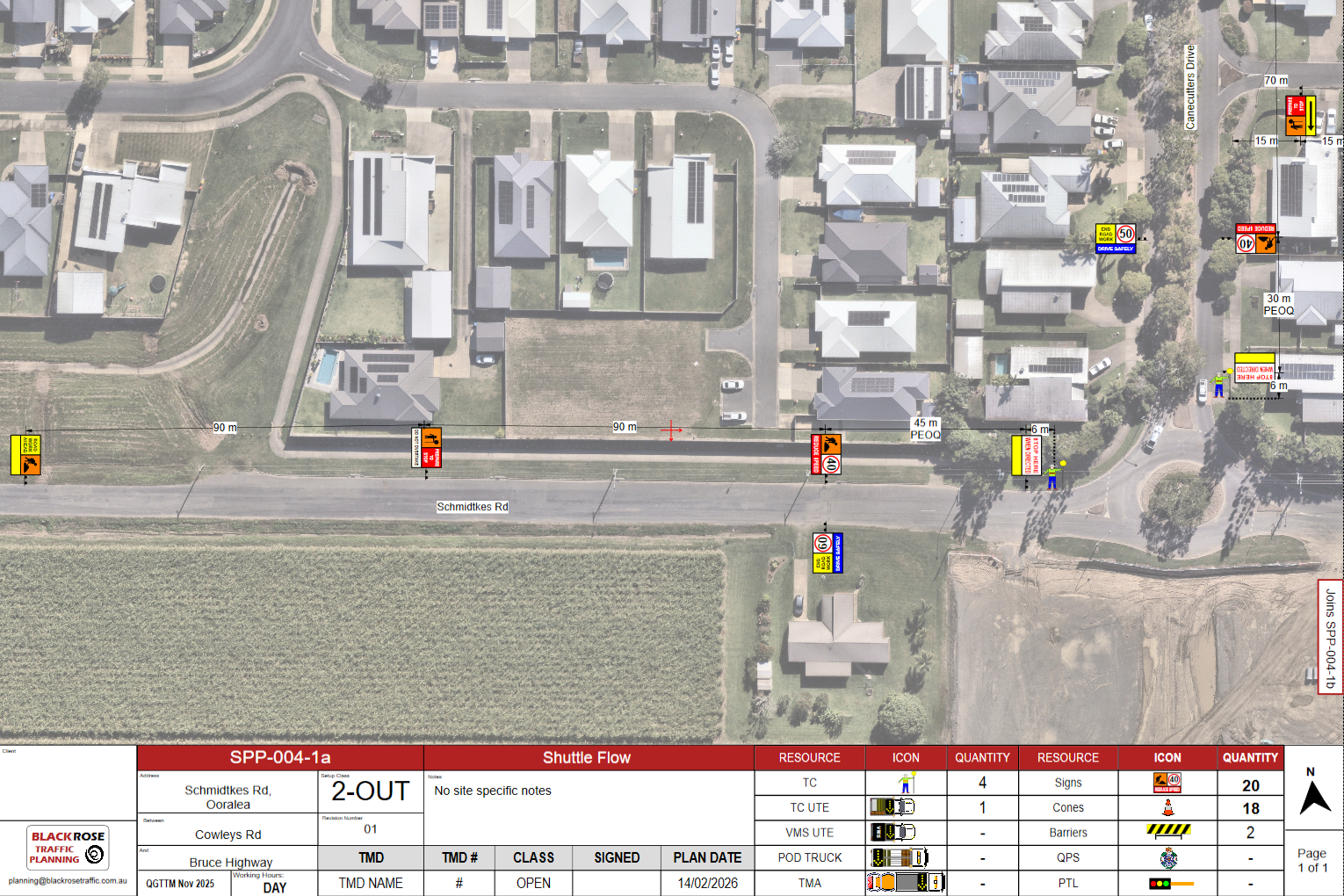
Here is an example of a page from a TGS provided by Blackrose Traffic Planning
What does the legislation say?
The Australian Guide to Temporary Traffic Management (AGTTM) defines a TGS as follows:
A Traffic Guidance Scheme (TGS) is a document that shows how traffic, pedestrians and vulnerable road users are to be separated from a worksite or work route. It is intended as an instruction from the Traffic management designer and the Principal contractor to the traffic management workers and is usually in the form of a diagram showing the road conditions (lanes, pedestrian routes, signs etc.) and how all road users are to be managed around the site /activities (temporary signs, posting of traffic control staff, etc.). A TGS is a work health and safety requirement of a worksite (i.e. should be held on site) and should comply with this AGTTM to comply with the relevant acts and codes of practice.
Frequently Asked Questions
-
Only qualified TMDs can design TGSs, additionally they must be working for a registered design company, such as Blackrose Traffic Planning!
-
No - TGSs cover every member of the public that will interact with your workzone. Whilst this includes cars, it also includes pedestrians, heavy vehicles and cyclists. Depending on the area they also might have control measures for children (if working near a school) or the elderly (if working near an aged care facility)
-
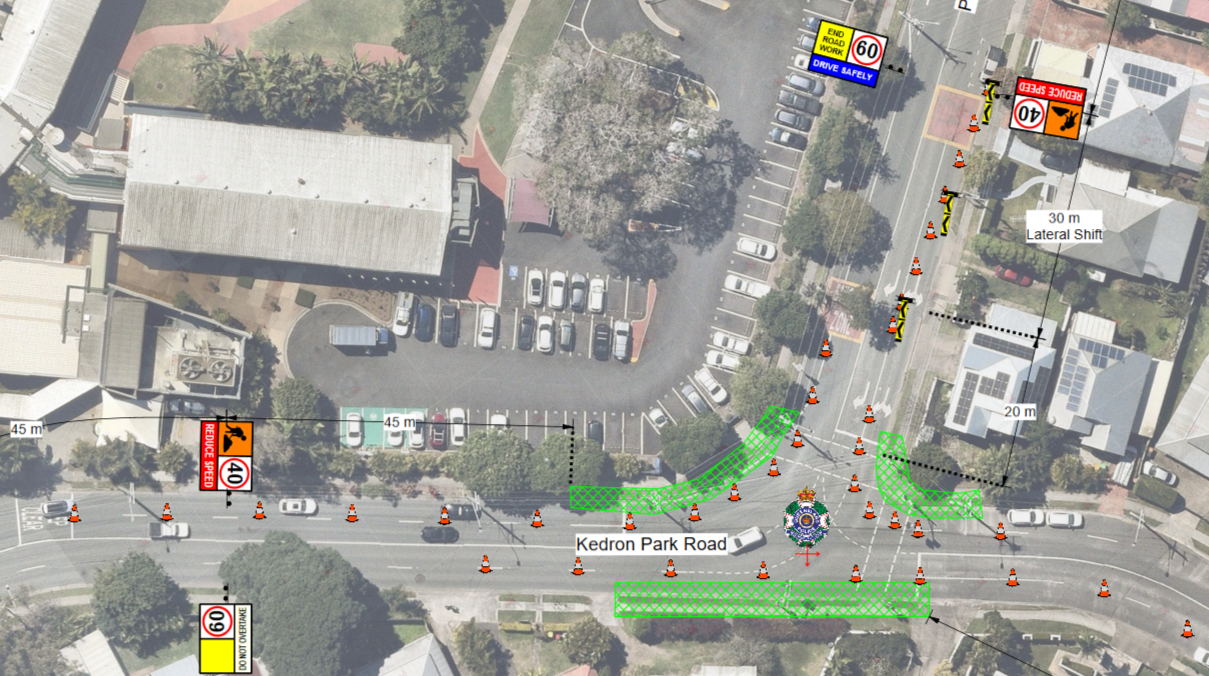
Not at all, our TGSs are created by utilising Rapidplan and a satellite basemap. However it can be created in any CAD software with no background or a drawn background. Technically they can even be hand drawn with a pencil, although we wouldn’t recommend it!
-
It doesn’t matter where you are working in QLD, if you are on a roadway owned by the council or TMR, you need a TGS. The complexity of that TGS might change compared to one in the middle of Brisbane, but a TGS is still required.
-
A site specific TGS is one designed specifically for a particular stretch of roadway. It can’t be used anywhere else and is the safest type of TGS since it leaves nothing up to chance.
-
A generic TGS is designed for a uniform piece of roadway. Think a straight road or a road with a simple intersection. It covers a common scenario and can be used anywhere in QLD that fits the road geography.
Generic TGSs are inferior to site specifics since they may be incorrectly used and cannot consider all the risks present. To utilise a generic TGS it must be made into a site suitable TGS by applying a checklist or by asking a TMD